Covenant and Nation
Building Through
The Twelve (12) Tribes of Israel
Study requires
meditation and reflection guided
by spiritual intellect and
Holy Spirit!
Romans 12:2
(AMP)
And do not be
conformed to this world
[any longer with
its superficial values and
customs],
but be
transformed and progressively
changed [as you mature
spiritually]
by the renewing of your mind [focusing on
godly values and ethical
attitudes],
so that you may
prove [for yourselves] what the
will of God is, that which is good
and acceptable and
perfect [in
His plan and purpose for you].
When we follow
twelve (12) through Scripture, a
recurring pattern emerges!
God • identifies,
• gathers, • orders
and • represents His
Covenant people.
Twelve (12)
frequently appears where the Lord
establishes a people who belong
to Him and bear
witness to His purpose!
The twelve
(12) tribes are a shadow of the
formation of Jesus selecting His
Twelve (12)
disciples.Whereby, we may understand
twelve (12) as a recurring
expression of Covenant fullness and the
ordered representation of God’s
people.
In this document,
Scripture develops the • The twelve (12) apostles
of Jesus Christ,
and • the repeated twelves (12)
of the New Jerusalem observed in
Book of Revelation.
The Book of Revelation is
primarily written in symbolic
language.
Symbolism must be
recognized as not being literal.
Let us engage in
these two aspects regarding the
New Jerusalem
Revelation 21:1–3 (AMP)
Then I saw a new
heaven and a new earth; for the
first heaven and the first earth
had passed away
(vanished), and there is no
longer any sea. And I saw the
holy city,
new Jerusalem,
coming down out of heaven from
God, arrayed like a bride
adorned
for her husband;
and then I heard a loud voice
from the throne, saying, “See!
The tabernacle of
God is among men, and He will
live among them, and they will
be His people, and
God Himself will be with them
[as their God,]”
New Jerusalem can be
understood within this spiritual
reading as the born-again
people of God, united
to Jesus Christ and made His
dwelling place through
the representation of
God the Holy Spirit.
The city portrays a
community whose life originates in
God, whose identity
is established in
Christ, and whose beauty comes
from His transforming presence.
John sees a city
adorned as a bride because the
vision brings together two
complementary
realities: God’s people are His
holy habitation, and they are
joined
in Covenant Love to
His Son.
Revelation
itself supplies a strong
foundation for this
connection.
[Note: Regarding all
biblical references posted in this
document that are not recorded
as text, consult and
search https://www.biblegateway.com
for the Amplified Bible.
In Revelation
21:9–10, the angel promises to
show John the Bride, the wife
of the Lamb, and then
shows him the holy city coming
down out of heaven from God.
The movement from
Bride to city makes the imagery
deeply personal and relational.
The city represents a
people belonging to the Lamb,
gathered into a shared life under
His lordship. Reading
New Jerusalem as Christ’s
spiritual church therefore rests
upon
the vision’s own
association between the city and
the Bride. Whether this exhausts
every dimension of
the vision is an interpretive
question. Its significance for
God’s
Covenant people is
firmly established!
The description
“coming down out of heaven from
God” reveals the heavenly source
of this community.
The church receives its spiritual
life from above. Jesus’ teaching
about being born of
the Spirit in John 3:3–8 provides
an essential connection!
Jesus discusses the
"born-again" requirement with
Nicodemus, a Pharisees, a ruler
(member of the
Sanhedrin) among the Jews.
The entrance into God’s
kingdom requires
a birth that God
Himself produces. New Jerusalem’s
heavenly origin thus corresponds
to the heavenly
origin of those who belong to
Christ. Human organization may
provide
a meeting place, but
only God can impart the life that
makes people His spiritual
habitation!
This heavenly origin
also reveals the direction of
God’s covenant purpose.
His presence comes to
dwell among His people. Heaven is
the abode of God,
yet God is not
confined to a distant place.
Through Christ and by the Spirit,
He brings His people
into fellowship with Himself. The
wonder of the vision
is expressed in its
announcement that God will live
among them.
The holy city becomes
a picture of heavenly life made
present within
a redeemed community!
The new heaven and
new earth may, within this
spiritual interpretation, portray
the renewed order of
life established through Jesus
Christ.
Paul’s teaching in 2
Corinthians 5:17 connects union
with Christ to new creation,
while Ephesians
2:14–18 describes people formerly
separated being brought together
through Him and
receiving access to the Father in
one Spirit. These passages support
an understanding of
newness that reaches into
identity, relationship, worship,
and belonging.
Applying this specifically to
Revelation’s heaven-and-earth
imagery
is a theological
interpretation, but it draws upon
the apostles’ clear proclamation
that Christ
establishes a new creation and a
reconciled people!
The passing of the
former order therefore speaks
powerfully of the transformation
from alienation to
communion! This is Supernatural!
• Those once
estranged from God become members
of His household!
• Those divided from
one another become one Body in
Christ!
• Those burdened by
guilt receive forgiveness and
access to the Father!
The church manifests
this newness as Christ’s life
reshapes its relationships,
affections, conduct,
and worship.
[Note: Whereas
heaven is the abode of God, the
sea often represents the abode
of evil (see
Daniel 7:3; Mark 5:13; Revelation
13:1)]
Daniel 7:3 (AMP)
“And four great
beasts came up out of the sea”
The verse describes
four different beasts emerging
from the sea.
In Daniel’s vision,
they represent kingdoms,
connecting the turbulent waters
with threatening
earthly powers.
Mark 5:13 (AMP)
“were drowned in the
sea.”
The verse describes
Jesus permitting the unclean
spirits to enter the pigs,
after which the herd
rushes down the steep bank into
the sea and drowns.
Revelation 13:1 (AMP)
“coming up out of the
sea”
John sees a beast
emerge with ten horns and seven
heads, crowns upon its horns,
and blasphemous names
upon its heads. Here the sea forms
the setting from which
a power opposed to
God appears.
Together, these
passages support an association
between the sea and threatening
powers, demonic
activity, and opposition to God.
They do not establish that every
biblical reference to
the sea means evil, nor does
Mark’s account explicitly define
the sea as the
dwelling place of demons.
Within Revelation’s
symbolic setting, however, the
disappearance of the sea
can express the
removal of the hostile disorder
from which the beast arose.
Spiritually applied,
the picture declares that evil has
no rightful throne within God’s
holy dwelling. The
church’s life is to be governed by
the Lamb rather than by fear,
deception, or
rebellion!
The Bride’s adornment
further reveals the character of
this redeemed community.
Her beauty arises
from belonging to Christ and
receiving His sanctifying love.
Ephesians 5:25–27
describes Christ loving the
church, giving Himself for her,
and cleansing her so
that He might present her in
holiness. This is the procession
of maturing the Body
into the full stature of Christ.
(Ephesians 4:13-16)
Christ in you is the
fullness of Himself!
Ephesians 4:13-16 (AMP)
13 until we all
reach oneness in the faith and
in the knowledge of the Son of
God,
[growing
spiritually] to become a mature
believer, reaching to the
measure
of the fullness of
Christ [manifesting His
spiritual completeness and
exercising our
spiritual gifts in
unity]. 14 So that we are no
longer children [spiritually
immature],
tossed back and
forth [like ships on a stormy
sea] and carried about by every
wind
of [shifting]
doctrine, by the cunning and
trickery of [unscrupulous] men,
by the deceitful
scheming of people ready to do
anything [for personal profit].
15 But speaking the
truth in love [in all
things—both our speech and our
lives
expressing His
truth], let us grow up in all
things into Him [following His
example]
who is the
Head—Christ. 16 From Him the
whole body [the church,
in all its various
parts], joined and knitted
firmly together by what every
joint supplies,
when each part is
working properly, causes the
body to grow and mature,
building
itself up in
[unselfish] love.
We walk many paths
that we retort are big mistakes.
However, God takes
each of these paths
with all of its rebellion and
disobedience and through His Agape
Love transforms them
into steps that eventually reveal
Christ working within us
through us! We are
the light to the world!
Colossians 1:27 (AMP)
God [in His eternal
plan] chose to make known to
them how great for the Gentiles
are the riches of
the glory of this mystery, which
is Christ in and among you,
the hope and
guarantee of [realizing the]
glory.
The Bride is formed through
the Bridegroom’s self-giving love!
Jesus declares that
His people carry the light of His
presence into the world.
Like a city set upon
a hill, the Body of Christ becomes
visible through love, truth,
mercy, and faithful
service. This light shines as
believers reflect His character
in everyday
relationships, bringing hope to
the discouraged and revealing
God’s
goodness through
their words and actions.
Matthew 5:14 (AMP)
“You are the light of [Christ to]
the world.
A city set on a hill
cannot be hidden;”
This city upon a hill
also offers a spiritual connection
to New Jerusalem, pictured
as a bride adorned
for her husband. In this
understanding, the born-again
Body of Christ is a
living community in whom God
dwells by His Spirit.
The Light of Christ
reveals the presence of Christ
within His people, making His love
and goodness visible
to the world. Together, they
express the beauty of His bride
and the wonder of God
making His dwelling among
humanity.
Once again:
Revelation 21:2–3 (AMP),
describing New Jerusalem as the
bride
and God’s dwelling
among His people.
The
announcement concerning the
tabernacle brings this imagery
into especially
clear focus.
Ephesians 2:19–22 describes
believers as God’s household,
built upon the
foundation of the apostles and
prophets, with Jesus Christ
as the cornerstone.
Together they grow into a holy
temple and become God’s dwelling
through the Spirit.
First Corinthians 12:13 likewise
connects the one Body with the
work
of the one Spirit.
These apostolic teachings explain
how the Body, the temple,
and the Bride
describe different aspects of the
same redeemed people:
• Their shared life,
• Their indwelling
presence,
• Their covenant
relationship with Christ.
The loud voice from
the throne announces the meaning
of what John sees!
Its source signifies
divine authority, and its message
declares divine nearness.
Revelation 21:3 does
not explicitly identify this voice
as the Holy Spirit speaking
within believers.
Nevertheless, the announcement has
a profound relationship
to the Spirit’s
indwelling ministry! Holy Spirit
makes known and brings believers
into the fellowship
with God that the voice proclaims!
Jesus explained this
ministry to His disciples in John
16:13–15.
Holy Spirit would
guide them into truth, glorify
Jesus, and disclose what belongs
to Him. Jesus also
declared that all the Father
possesses belongs to Him.
Holy Spirit’s
revelation therefore joins the
disciples to the truth and riches
of Christ,
making the Son known
in accordance with the Father’s
purpose!
The promise was first
addressed to His (12) disciples.
The church receives their
apostolic witness and continues to
depend upon Holy Spirit
to understand and
live by that truth.
This gives substance
to the thought of an indwelling
voice!
Holy Spirit:
• Illuminates the
Word,
• Brings Christ’s
teaching to remembrance,
• Convicts,
• Comforts,
• Forms obedience
within believers.
His ministry
glorifies Jesus. An inward
impression should therefore be
received
with discernment and
measured against the apostolic
testimony of Scripture.
Spiritual
illumination deepens our
understanding of Christ and
produces a life
consistent with His
character!
John 14:23 provides
another vital connection: Jesus
promises that the Father
and the Son will make
their home with the person who
loves Him and keeps His word.
Here the
language of divine
habitation becomes personal.
Ephesians 2 extends
that habitation to
the gathered community. God dwells
within believers, and He builds
them together as His
dwelling. New Jerusalem
beautifully gathers these personal
and
corporate realities
into one vision.
Consequently, New
Jerusalem as the born-again Body
of Christ carries a practical
calling.
A city is a shared
habitation. Its people must learn
to live together under the
authority
of their King.
Christ’s presence becomes evident
as they forgive, care for the
vulnerable,
speak truth, pursue
reconciliation, and offer what
they have freely received.
The Bride’s devotion
is expressed through the Body’s
service, and the temple’s holiness
is expressed through
the community’s daily life.
The central
proclamation is therefore deeply
relational: God has made a people
His own,
and He dwells among
them. In this spiritual reading,
New Jerusalem portrays the church
receiving its life
from heaven, its identity from the
Lamb, and its understanding
through
the Holy Spirit. The
Spirit reveals the things of
Christ so that His people may know
their Bridegroom,
walk in His truth, and manifest
His love.
The glory of
the city is the glory of God
present within His redeemed
people—
a living testimony
that His covenant purpose is
fellowship, holiness, and
communion
with Himself.
The powerful
“Divine Key” is the essence of
what these passages reveal!
God knows His
people, gives them their place,
and joins them together within His
purpose!
Genesis
35:22–26 identifies the twelve
sons of Jacob, from whom the
tribes of Israel
descend.Their family history
includes • rivalry, • failure, •
suffering • reconciliation,
and • extraordinary
providence!
[Note
Numeri’s... (biblical numbers)
help us contemplate theme and
meaning...
without
becoming a code that determines
the meaning.
The study of
Numeric(s) is not Numerology!
It is the application
of relational spiritual and
physical realities, not doctrines
nor man-made
religious traditions.]
For a
comprehensive study into
‘Numeric(s) search ”Marvelous
Wonders”
The link is
posted on Inner
Chambers of The
Prophetic Voice web page:
God’s
Covenant purpose is advanced
through His • correction
and • mercy.
This helps us
understand the difference between
God’s • ways and • mankind’s ways.
Human judgment
may see a troubled household;
divine wisdom sees the unfolding
history of a Covenant
people.
The significance of
twelve (12) begins with God’s
faithfulness, rather than the
perfection
of the men whose
names the tribes would bear!
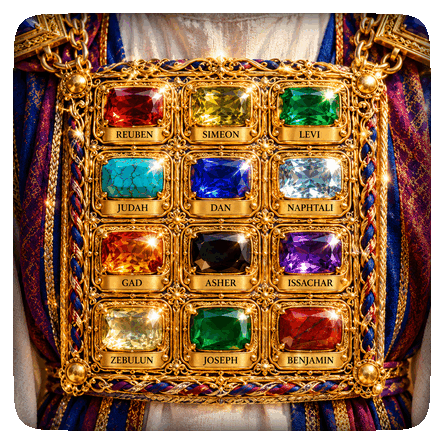
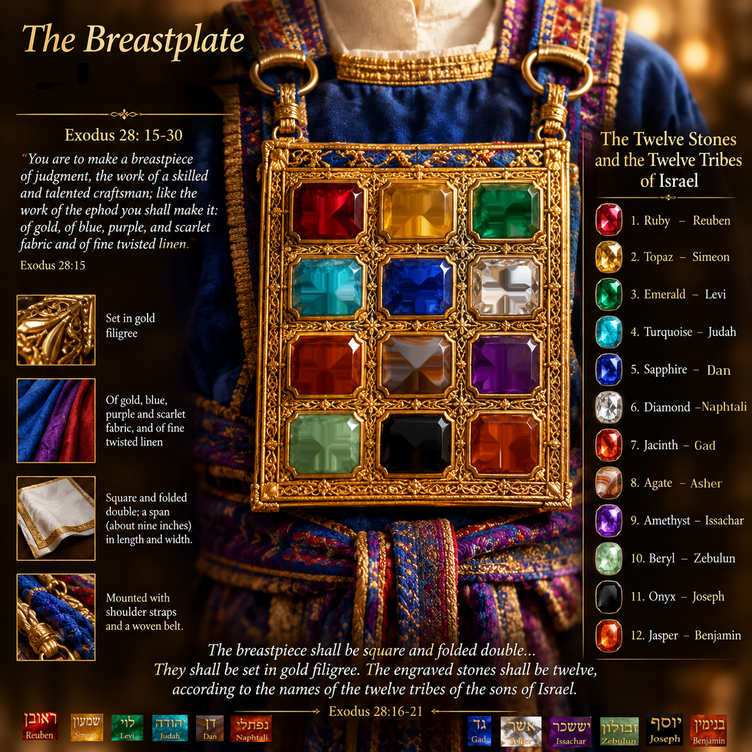
Exodus
28:15–21 carries this pattern
into the high priest’s
breastpiece.
Twelve (12) precious stones bear
the names of the tribes of
Israel,
one name upon each
stone.
Exodus
28:15-21 (AMP) [There are a
multitude of “numeric(s)”
incorporated in
this passage]:
15 “You are
to make a breastpiece of
judgment, the work of a skilled
and talented
craftsman; like the work of the
ephod you shall make it: of
gold, of blue, purple,
and scarlet
fabric and of fine twisted
linen.
16 The
breastpiece shall be square and
folded double;
a span [about nine
inches] in length and a span in
width.
17 You shall
mount on it four rows of stones:
the first row shall
be a row of ruby, topaz, and
emerald;
18 the second
row a turquoise, a sapphire, and
a diamond;
19 the third
row a jacinth, an agate, and an
amethyst;
20 and the
fourth row a beryl and an onyx
and a jasper;
they shall be
set in gold filigree.
21 The
[engraved] stones shall be
twelve, according
to the names of
[the twelve tribes of]
the sons of Israel; they shall
be like the engravings of a
signet,
each with its name
for the twelve tribes.
Exodus 28:29
explains that Aaron carries those
names
near his heart when
he enters the holy place. He, a
called and chosen vessel
was the only “one” to
carry the twelve stones embedded
upon His breast!
The tribes are
distinguished by name yet gathered
together
upon “one”
breastpiece and carried by “one”
priest before the Lord.
Exodus 28:29 (AMP)
29 So Aaron shall
carry the names of the sons of
Israel (Jacob) in the
breastpiece
of judgment over
his heart when he enters the
Holy Place, to bring them in
continual
remembrance before
the Lord.
The stones
upon Aaron’s breastpiece were
carried over his heart,
bringing the
names of Israel before the
Lord.
The twelve
precious stones represented
people held inthe place of
remembrance,
love, and
priestly intercession. Aaron
carried their names!
Jesus Christ, our
great High Priest, carries His
people in the fullness of His
love.
The breastpiece
presents a remarkable
gathering,of biblical
numeric(s):
• Three sacred
places,
• One priestly
representative,
• Twelve named
tribes carried near his heart.
Together, these
features offer a devotional
picture of distinction held
within unity,
with God’s people
brought before Him through an
appointed mediator!
The Body of
Christ are those who abide in
the Lord's commands!
Matthew 22:37 (AMP)
And Jesus
replied to him, “‘You shall
love the Lord your God
with all your
heart, and with all your
soul, and with all your
mind.’
Numerics of three
(3):
• With all your
heart,
• With all your
soul,
• With all your
mind.
Can you “see” the
similitude of the Lord Jesus
Christ and His Body?
The numeric
“One” as described is symbolism
regarding Our God is One…
The numic 3
understood as three persons,
Father, Son and Holy Ghost/Spirit
and perpetuating
Will, Plan and Ways!
[Note: Will =
Vision; Plan = Purpose; Ways =
Action]
The tribe’s
differences are attributed within
a shared relationship with God.
In the fuller
Revelation of Jesus Christ, our
great High Priest,
we observe the living
reality of His faithful
representation of His people to
the Father!
We belong to
Him, and He knows those whom He
brings near!
The stones are
placed upon the breastpiece, the
location near the heart.
for Divne recognition
and assignments and greatness in
His Presence!
Recall that
John the Beloved laid his head
upon Christ’s breast (bosom).
As Aaron
carried the names of Israel’s
tribes upon one breastpiece
over his heart, we
may see a devotional picture of a
people whose
distinctions are
preserved within a shared Covenant
relationship!
Their names are not
erased by their gathering
together!
In Christ,
their names are preserved in the
Book of Life!
Revelation 3:5
(AMP)
He who
overcomes [the world through
believing that Jesus is the
Son of God] will
accordingly be dressed in white
clothing;
and I will never blot
out his name from the Book of
Life,
and I will confess
and openly acknowledge his name
before My
Father and before His angels
[saying that he is
one of Mine].
In the greater
reality revealed through Jesus
Christ,
belonging to Him does
not abolish our identity in Him!
It brings each life
into the fellowship of His love!
“One God”
declares the unity of the
indwelling Divine Being in Christ!
1
Timothy 2:5 (AMP)
For there is [only]
one God, and [only] one Mediator
between God and
mankind, the Man Christ Jesus,
Our identiy grows
from what Scripture describes!
1. One God (Father,
Son, Holy Spirit)
2. One Mediator
(Son of God/Spirit of God)
3. One mankind
(Humanity)
The Man Jesus
Christ recognized in three-fold
(3) distinctive
ways (unified ).
1 Timothy 2:5
passage opens a beautiful
conversation about
distinction held within unity!
Father God’s people
are known individually,
yet brought
together before Him through
Jesus Christ!
His appointed
Mediator!
Colossians 2:9
(AMP)
For in Him all
the fullness of Deity (the
Godhead) dwells in bodily form
[completely
expressing the divine essence of
God].
The Father, the
Son, and Holy Spirit are distinct
Persons, eternally
sharing One Divine
Nature.
They are not
three separate gods, nor three
temporary
expressions of one
Person.
Within this
Divine Unity (One), the Father
sends the Son.
The Son accomplishes
our reconciliation, and Holy
Spirit brings us
into the living
experience of communion with the
Godhead!
These
distinctions reveal the richness
of Christ’s Life and the
Holy Trinity’s
united purpose of
Redemption.
For a
comprehensive study into “Divine
Holy Trinity,”
the link is posted on
Inner Chambers of The Prophetic Voice web
page:
“One Mediator” identifies Jesus
Christ Himself. He is the eternal
Son of God
who truly
became man, joining Divine and
human natures in One Person.
His mediation is
therefore profoundly personal!
Christ reveals
Father God to each redeemed
through His own Life and sacrifice
on the Cross of
Gogotha (Skull Mount).
Through Faith
He brings humanity before the
Father through His own redeeming
work!
The Holy Spirit
unites us to Christ and makes His
Presence
known within us, but
“Son of God” and “Spirit of God”
should not be
treated as
interchangeable personal
identities.
Holy Spirit is the
Spirit of the Lord!
The Son is our
Mediator; the Holy Spirit brings
us into participation
in the relationship
the Son has secured!
The Holy Spirit
leads us to Jesus Christ and makes
the Presence of the
Risen Lord known within us.
Through His
indwelling, our relationship with
Christ
becomes a living
communion!
We receive
Christ's love, grow in His truth,
and are strengthened
to walk in His ways!
The Spirit
brings us into intimate (close,
inseparable) fellowship
with the Son and,
through the Son, into fellowship
with the Father!
Within this
Divine communion, Unity preserves
personal distinction:
“Son of God”
and “Spirit of God!”
The Son is the
One who became flesh, gave Himself
for our redemption,
and rose from the dead.
The Holy Spirit bears
witness to the Son, glorifies Him,
and brings His people
into the present life of
righteousness
and eternal life in
His Presence in which He has
secured!
Jesus expresses this
relationship in John 16:14, where
the Spirit
glorifies Him by
taking what belongs to Him and
revealing it to His disciples.
John 16:14
(AMP)
14 He will
glorify and honor Me, because He
(the Holy Spirit)
will take from what
is Mine and will disclose it to
you.
The Spirit’s
ministry reveals the Son through a
communion in which
neither loses His
personal identity. Father, Son,
and Holy Spirit
are distinct Persons
in the Undivided Life of our One
God!
[Note: Does
this narrative help You understand
the nature and
relationship of three (3) Persons
of the One God?]
For a comprehensive study
into the “Divine
Holy Trinity“ the link
is posted on
Inner Chambers of The
Prophetic Voice web page.
When Paul
speaks of liberty where the Spirit
of the Lord is in 2
Corinthians 3:17, he directs our
attention to the transforming Presence of God
among His people.
2 Corinthians
3:17 (AMP)
17 Now the Lord
is the Spirit, and where the
Spirit of the Lord is,
there is
liberty [emancipation from
bondage, true freedom].
Holy Spirit is
no impersonal influence; He is the
Divine Person
who teaches, leads,
comforts, and sanctifies us.
Through Him,
Christ’s Presence is
known within us, and our lives
increasingly
reflect Christ’s
character. What a marvelous unity!
The Father
receives us through the Son, and
the Holy Spirit makes
this fellowship
living and active within our
hearts—Now! Today!
“One mankind”
may express our shared humanity,
although Paul’s
verse says “mankind”
without assigning it the numeral
one.
We belong to one
human family, yet remain many
persons,
with different names,
histories, gifts, and needs.
Christ’s
mediation reaches across those
human distinctions.
No tribe, nation, or
social position possesses a
separate doorway
to the Father. Our
unity is found in the same Christ
through
whom we are
reconciled to God
and gathered into His
covenant people.
We can
therefore contemplate Jesus Christ
in three unified
relationships.
• As the Son,
He eternally shares the Divine
Nature
with the
Father and the Holy Spirit!
• As Man, He
truly shares our humanity!
• As Mediator,
He reconciles us to God!
These are not
three persons within Jesus, but
three ways
of considering the
identity and work of Christ!
His divine
identity, His genuine humanity,
and His mediating work
belong together! The
wonder is that the One who brings
us
before God also loves
us personally!
As the names
upon Aaron’s breastpiece rested
over his heart,
so this devotional
picture directs our attention
toward
Christ’s faithful
love:
many people,
individually known, and gathered
into one Covenant
fellowship through
one Mediator!
Exodus 28:29
places the names of Israel over
Aaron’s heart
whenever he enters
the Holy Place,
as a continual
memorial before the Lord!
Twelve
therefore represents the whole
Covenant people in this setting!
Each tribe
retained its own name and its own
stone, yet all belonged
upon one breastpiece.
Their unity did not erase their
identity.
What a beautiful
expression of Covenant belonging:
many names,
each remembered, gathered together
and carried close to
one heart!
This pattern
continues in the twelve apostles
and in the twelve tribal names
and twelve apostolic
foundations of the New Jerusalem!
Revelation
21:12–14 (AMP) Spiritual New
Jerusalem
12 It had a
massive and high wall, with twelve
[large] gates, and at the gates
[were stationed] twelve angels; and on the
gates the names of the twelve
tribes
of the sons of
Israel were written.
13 On the east side
[there were] three gates, on the
north
three gates, on the
south three gates, and on the west
three gates.
14 And the wall of
the city had twelve foundation
stones,
and on them the
twelve names of the twelve
apostles of the Lamb (Christ).
The one
breastpiece and the one high
priest emphasize the unity of that
representation.
Aaron, appointed by
God, bore the names together
before the Lord.
Other priests served
in the Holy Place, but the High
priest alone entered
the Most Holy Place on the appointed Day of
Atonement.
[Note: Atonement,
atoning, or making amends is the
concept of a person taking
action
to correct previous
wrongdoing on their part, either
through direct action to undo
the consequences of
that act, equivalent action to do
good for others, or some other
expression of
feelings of remorse. Disobedience
and rebellion toward God requires
Atonement!
It is closely
associated to:
• forgiveness,
• reconciliation,
• sorrow,
• remorse,
• repentance,
• reparation, and
• guilt.
• It can be seen as a
necessary step on a path to
redemption
• Expiation (showing
that you are sorry for bad
behavior) is the related concept
of removing guilt,
particularly the undoing of sin or
other transgressions.]
Hebrews 9:6-7
(AMP)
6 Now when
these things have been prepared
in this way, the priests
continually
enter the outer [or
first section of the] tabernacle
[that is, the Holy Place]
performing [their ritual acts of]
the divine worship,
7 but into
the second [inner tabernacle,
the Holy of Holies], only the
high priest
enters [and then
only] once a year, and never
without [bringing a sacrifice
of] blood,
which he offers [as a
substitutionary atonement] for
himself and for the sins
of the people
committed in ignorance.
Thus, the
significance of “one” here
concerns his distinctive
appointment:
one representative
carrying the whole people.
This once again,
directs our attention toward Jesus
Christ, the one mediator
between God and
humanity.
[Nore: (1
Timothy 2:5). His people have many
names, histories, and gifts,
yet their
access to the Father rests in
Christ!]
1 Timothy 2:5 (AMP)
5 For there is [only] one God,
and [only] one Mediator
between God and
mankind, the Man Christ Jesus,
The Tabernacle
arrangement included three
principal areas:
• the outer court,
• the Holy
Place,
• the Most Holy
Place.
Strictly speaking,
the tent itself contained the
latter two;
the court
surrounded it. These three areas
reveal degrees
of access and
holiness within the worship God
established.
We may
contemplate them alongside God’s
revelation as Father, Son, and
Holy Spirit,
but Scripture does
not explicitly identify the three
areas as the three divine Persons.
The Trinity
rests upon God’s revelation of
Himself, rather than upon the
number
of architectural
spaces.
Once again, our
reflection upon “one” and “three”
opens for rich meditation:
our God is one
God, eternally Father, Son, and
Holy Spirit!
• The Father
loves and sends!
• The Son
accomplishes Redemption
and
serves as our great High Priest!
• The Holy
Spirit brings us into the living
experience
of that
Redemption.
Ephesians 2:18
gathers this relationship
beautifully!
Through Christ,
believers have access in one
Spirit to the Father.
God is Spirit
and Truth!
One God is
therefore deeply personal—received by
• the Father,
• through the Son,
• in the Holy Spirit!
The three
Persons are distinct, yet God is
indivisibly One!
Ephesians
2:18 (AMP)
18 For it is through Him that we
both have a [direct] way
of approach in one
Spirit to the Father.
Here, numeric
twelve (12) becomes an invitation
to deeper understanding!
Twelve (12)
draws our attention to the
Covenant people
in their fullness in
God’s Government!
One (1) draws
our attention to their United
representation and their mediator.
Three (3)
invites reflection upon the
fullness of God’s revealed life,
while retaining the
distinction between biblical
teaching and devotional symbolism.
Aaron carried
twelve names over his heart, but
Christ knows and loves every
person
who belongs to Him.
John’s resting upon
His breast brings the meditation into intimate focus!
The people
represented before God are loved by the One who
represents them!
The Divine Key
is Covenant completion—many
persons gathered in Christ,
welcomed before the
Father and made alive by the Holy
Spirit!
John reclined
close to Jesus’ breast at the
supper.
[An interesting
thought: could John hear the Heart
Beat of God?]
John 13:23-25
(AMP)
23 One of His
disciples, whom Jesus loved
(esteemed),
was leaning against
Jesus’ chest.
24 So Simon Peter motioned to
him (John) and [quietly] asked
[him to ask Jesus]
of whom He was speaking.
25 Then leaning
back against Jesus’ chest,
he (John) asked Him
[privately], “Lord, who is it?”
Physically, it
is possible, though Scripture does
not tell us that he did.
Jesus possessed a
real human body with a real
beating heart.
Because He is
the eternal Son made flesh, we may
reverently describe
this as listening to
the heartbeat of God
incarnate—while recognizing
that God’s Divine
Nature is Spirit and has no physical
heartbeat.
The deeper
wonder is what John’s nearness
reveals!
He rested
beside the heart of the One who
would give His Life for him!
The names
carried upon Aaron’s heart find
their greater expression
in the people loved
by Christ.
John’s posture
becomes a beautiful invitation for
us
• To draw near
enough to listen,
• Rest securely
in His love,
• Let His
compassion shape our own hearts.
We cannot claim
that John heard a heartbeat,
but we can say that
he encountered
the heart of
God revealed in Jesus Christ!
Leviticus
24:5–9 describes twelve loaves
placed before the Lord
in two rows of six.These loaves belong to
Israel’s continuing Worship
and Covenant life.
The number
twelve again appears in the
Presence of God,
where the people’s
relationship with Him is
acknowledged!
Read Christ’s
Revelation of Himself as the Bread
of Life...
John 6:35 (AMP)
35 Jesus
replied to them, “I am the Bread
of Life. The one who comes to Me
will never be
hungry, and the one who believes
in Me [as Savior]
will never be
thirsty [for that one will
besustained spiritually].
Our attention
moves toward the One who sustains
His people!
Through Christ’s
testimony, a people is gathered
and He provides
for their life with
Him!
We walk deeper into
understanding when belonging and
dependence
become inseparable! The people of the New
Covenant continually need
the provision of the Covenant Maker!
For a wonderful
deeper study, consider: “Covenant_Maker”
and “Covenant
Maker Revisited” listed
on Inner
Chambers of The
Prophetic Voice:
Christ, the
Bread of the Presence:
The Divine Nature Revealed
in Covenant Fellowship
Leviticus
24:5–9 (AMP)
5 “Then you
shall take fine flour and bake
twelve cakes
(bread of the
Presence, showbread) with it;
two-tenths of an ephah
shall be in each
cake (loaf).
6 You shall
set the bread of the Presence
(showbread) in two rows,
six in a row, on
the pure gold table before the
Lord.
7 You shall
put pure frankincense [in two
censers, one]
beside each row, so
that it may be with the bread
as a memorial
portion, an offering by fire to
the Lord.
8 Every
Sabbath day Aaron shall arrange
the showbread
before the Lord
continually;
it is an
everlasting covenant for the
Israelites.
9 The bread
of the Presence shall be for
Aaron and his sons,
and they shall eat
it in a sacred place, for it is
for Aaron
a most holy portion
of the offerings by fire to the
Lord,
his portion forever.”
Within the
sanctuary of Israel, twelve loaves
rested
upon a pure gold
table before the Lord.
Their placement
declared that the Covenant
people belonged
before Him continually.
• Beyond the
wilderness,
• Beyond their
changing circumstances,
• Beyond the
limitations of their own strength,
God had
appointed a place for them in His
Presence!
The bread was a
tangible expression of Covenant
Relationship:
• Provision
received from God,
• Presented
before God,
• Shared by
those appointed to serve God.
When we
contemplate this ordinance through
Jesus Christ,
its imagery opens a
rich meditation
upon Divine
Presence, Holiness, Faithfulness,
and Fellowship!
Within that
meditation, the bread also
provides a fitting picture
of the nourishment we
receive through the Word of God!
Each of these
provide a theme to open other
“Patterns of the Son!”
Leviticus does
not explicitly identify the
showbread as Scripture.
This spiritual
connection develops through the
wider biblical
witness concerning
• Bread,
• Divine
provision,
• God’s
life-giving Word.
Matthew 4:4
(AMP)
But Jesus
replied, “It is written and
forever remains written,
‘Man shall not
live by bread alone,
but by every
word that comes out of the mouth
of God.’”
This
proclamation establishes a
“governing “truth for our study.
Physical bread
sustains the body, while the Word
proceeding from God
sustains our life of faith and
obedience!
Jesus spoke these
words during His wilderness
testing,
drawing upon the
lesson of Israel’s wilderness
journey!
Deuteronomy 8:3
(AMP)
3 He humbled
you and allowed you to be hungry
and fed you
with manna, [a
substance] which you did not know,
nor did your fathers
know, so that He
might make you understand [by
personal experience]
that man does not
live by bread alone, but man lives
by every word
that proceeds
out of the mouth of the Lord.
God’s provision
of manna taught His people to
depend upon Him!
Bread was
necessary, but bread alone could
never explain
or sustain their
Covenant life. Their existence
depended upon the God
who spoke, provided,
guided, and preserved them!
Jesus, hungry
in the wilderness, remained
obedient
to His Father’s Word.
• He refused to
make bodily appetite
the
governing authority of His
actions.
• His answer
calls us into that same
dependence!
• We receive
God’s provision while allowing His
Word to
direct how we
live!
The designation
“bread of the Presence” draws our
attention
first to
relationship.
The bread stood
before the Lord, continually
associated
with His Holy
dwelling among
His people. In
Jesus Christ, this theme reaches a
greater depth!
The
eternal Son truly entered human
life and made the Father known!
John 1:1–14
(AMP) reveals Him as the eternal
Word who became flesh:
The Deity of Jesus Christ
1 In the
beginning [before all time] was
the Word (Christ), and the Word
was with God, and the Word was God
Himself. 2 He was
[continually existing] in the
beginning [co-eternally]
with God. 3 All
things were made and came into
existence through Him;
and without Him not
even one thing was made that has
come into being.
4 In Him was life
[and the power to bestow life],
and the life was the Light of men.
5 The Light shines on
in the darkness, and the darkness
did not understand it
or overpower it or
appropriate it or absorb it [and
is unreceptive to it].
The Witness of John the Baptist
6 There came a
man commissioned and sent from
God, whose name was
John.
7 This man came
as a witness, to testify about the
Light,
so that all might
believe [in Christ, the Light]
through him.
8 John was not the
Light, but came to testify about
the Light.
9 There it
was—the true Light [the genuine,
perfect, steadfast Light] which,
coming into the world, enlightens everyone.
10 He (Christ) was in
the world, and though the world
was made through Him,
the world did not
recognize Him.
11 He came to that
which was His own
[that which
belonged to Him—His world, His
creation, His possession],
and those who were His own [people—the Jewish
nation] did not receive
and welcome Him.
12 But to as many as did receive and welcome
Him, He gave the right [the
authority,
the privilege] to
become children of God, that is,
to those who believe in (adhere
to,
trust in, and rely
on) His name—
13 who were
born, not of blood [natural
conception], nor of the will of
the flesh
[physical impulse], nor of the will
of man [that of a natural father],
but of God
[that is, a divine
and supernatural birth—they are
born of God—
spiritually
transformed, renewed, sanctified].
The Word Made Flesh
14 And
the Word (Christ) became flesh,
and lived among us;
and we
[actually] saw His glory, glory as belongs to the
[One and]
only begotten
Son of the Father, [the Son who is
truly unique, the only One of
His kind,
who is] full of
grace and truth (absolutely free
of deception).
Here the relationship between
Bread and the Word
becomes especially rich!
Christ is the
living Word, and He identifies
Himself as the Bread of Life. The
Scriptures bear witness to Him,
conveying the truth through which
we come
• to know, •
trust, and • follow Him.
The • written
Word and the • incarnate Word are
closely related, while remaining
distinct!
Scripture is
God’s inspired testimony, and
Jesus Christ is the Divine Person
to whom
that testimony
leads! Christ brings us into
fellowship with God because He
Himself
shares the Divine
Nature!
Hebrews 1:3
(AMP) describes the Son as the
radiance of God’s glory
and the exact
expression of His Nature!
3 The Son is
the radiance and only expression
of the glory of [our awesome] God
[reflecting
God’s Shekinah glory, the
Light-being, the brilliant light
of the divine],
and the exact
representation and perfect imprint
of His [Father’s] essence,
and upholding
and maintaining and propelling all
things [the entire physical and
spiritual
universe] by
His powerful word [carrying the
universe along to its
predetermined goal].
When He
[Himself and no other] had [by
offering Himself on the cross as a
sacrifice for sin]
accomplished
purification from sins and
established our freedom from
guilt,
He sat down
[revealing His completed work] at
the right hand of the Majesty on
high
[revealing His
Divine authority],
• He reveals
God with a fullness that the
sanctuary’s furnishings could only
anticipate.
• His mercy
reveals divine compassion;
• His
righteousness reveals divine
holiness;
• His
faithfulness reveals the
steadfastness of God’s love.
As we receive
the Bread of the Word of God, we
learn to recognize these qualities
in Him!
Scripture
nourishes our understanding so
that our view of Christ is formed by
God’s revelation rather than by
our own imagination.
For a
comprehensive deep study into “Glory to Glory”
the link is posted
on Inner Chambersof The Prophetic Voice web
page.
Here we must
hold together • the wonder of His
deity and • the reality of His
humanity.
Jesus entered
the ordinary conditions of human
existence while remaining
the eternal Son!
• He
experienced hunger, weariness,
sorrow, and suffering.
• His humanity
was real,
• His divine
nature was undiminished.
• His
wilderness proclamation is
especially powerful in this light!
The One Who is
the eternal Word lived a genuinely
human life of obedience to the
Father’s
Word! The Son’s
becoming flesh did not mean that
the • Father and • Holy Spirit
became
interchangeable
identities with Him. The Son made
the Father known, and through the
Holy
Spirit
believers • receive and •
experience the life of the risen
Christ.
The fine flour
invites a devotional consideration
of the • purity and • integrity of
Christ’s
human life.
Leviticus specifies the quality of
the flour without explaining it as
a symbol
of His
character. Yet, when we read this
sacred preparation alongside the
New Testament’s
witness to His
sinlessness, the connection
becomes fruitful! In Christ there
was
• no corruption of motive,
• no falsehood within
His obedience, and • no division
between His love
and
His righteousness!
• His
gentleness never compromised
truth;
• His authority
never served selfish ambition.
• Every
expression of His humanity
faithfully manifested His holy
character.
The Bread of
the Word of God nourishes this
same integrity within His people!
As we receive
its
• instruction,
• correction,
• promises, and
• wisdom, Holy
Spirit brings
our • thoughts
and • conduct into greater
agreement with Christ.
We learn:
• Truthfulness
in speech,
• Purity in
intention,
• Faithfulness
in service, and
• Love
expressed through action.
Spiritual
nourishment involves more than
accumulating biblical information.
The Word is
received deeply when its truth
becomes obedience and its wisdom
shapes our relationships.
Our preparation
in the Bread also brings suffering
into our meditation.
Flour becomes a
loaf through a process that
includes heat!
The passage
does not explicitly identify this
baking with Christ’s passion,
but the image can
help us
contemplate the obedience through
which He gave Himself for us!
His suffering
did not produce His deity or
purify Him from sin. He was
already Holy!
Through
suffering, however, His obedience
was lived out within the full cost
of our human condition! His love endured
• rejection, • betrayal, •
humiliation,
and • death.The One who sustains life
entered death to bring His people
into the Life of His
Resurrection!
The twelve (12)
loaves naturally recall the twelve
(12) tribes of Israel.
The entire Covenant community was represented
before the Lord.
No tribe supplied the
whole picture by itself!
No ministry
provides the whole Gospel by
itself nor does it express and
promote
the Kingdom of God by itself! Together
all the Tribes were the people God
of which
had gathered to
Himself!
This is
symbolic of Christ calling His
twelve (12) disciples who were
gathered
to gather a people to Himself!
Twelve (12)
therefore has a clear biblical
association with the ordered
fullness
of a Covenant people. Jesus’ appointment
of twelve (12) apostles later
carries
that
association into HisKingdom ministry!
Its beauty
here is the assurance of
belonging!
The people were
many, yet their place before God
was shared!
This shared
provision also illuminates our
relationship with the Word!
God’s truth
nourishes the whole community of
faith!
Each believer
receives its instruction, and together we learn to
walk in its Light!
The Bread of the Word
of God strengthens our unity by drawing us
toward
• the same Lord, •
the same gospel, and • the same
calling to love.
Its nourishment
equips us to build one another up,
bearing witness together
to the character of Christ!
The two rows of
six (6) loves deepens the visual
impression of distinction
within a common fellowship!
There were:
• separate loaves,
• an ordered
arrangement,
• one table before one Lord.
Leviticus does not
explain the two (2) rows as a
prediction of particular groups
or as a formula for
the Divine Nature. Its stated
arrangement is already meaningful!
God’s people
were presented with order and
care. In Christ, unity likewise
preserves the reality of individual persons. Each
believer has • a life, • a
calling,
and •
responsibilities, yet all depend upon the
same Savior. • His Word directs
our different gifts
toward a shared purpose, and • His Presence
gathers us
into faithful
service!
The pure gold
table provided a setting worthy of
this Holy offering.
Gold was a precious material used throughout
the sanctuary, expressing the
honor
due to God! As a devotional picture,
the table can direct our attention
to the • dignity
and • stability of the fellowship Christ
establishes.
Our acceptance before
God rests upon His faithful mediation!
We are upheld by the
One who knows us completely and
has given Himself for us!
The sanctuary
table bore the bread; our Savior
brings His people before the
Father.
Within this
fellowship, the Word of God
becomes daily nourishment for
those
learning to abide in
Him.
Beside the
bread stood pure frankincense, an
appointed a memorial portion
and an offering by fire. The fragrance
belonged to worship, directed
attention
toward the Lord
before Whom the bread was placed. God’s
gifts call forth
• thanksgiving, •
consecration, and • praise!
Receiving the
bread of His Word should therefore
awaken worship!
Yes! Indeed,
adulation!
• His promises
inspire gratitude!
• His holiness
inspires reverence;
• His mercy
inspires love.
Through Christ, the life we
receive becomes a life we offer: a
life founded
upon our • words, • labor, • generosity, and
• patience! Obedience becomes
expressions of
thanksgiving! We come to His table
hungry, and we rise
from fellowship ready
to serve!The memorial portion for the
High Priest
also speaks within
the language of Covenant Remembrance!
It points to the
‘Passover meal with Christ’s
twelve (12) chosen forerunners!
Luke 22:19
(AMP)
And when He
had taken bread and given
thanks, He broke it and gave it
to them,
saying, “This
is My body which is given for
you; do this in remembrance of
Me.”
God does not
require reminders because His
knowledge fails!
Such appointed
acts give His people a way to
acknowledge and participate
in the Covenant relationship He has
established! They bring His
faithfulness
into the practice of
worship!
The Word of God
continually calls His people
• to remember His
works,
• trust His promises,
and
• honor His commands!
In Christ,
remembrance becomes an active
response to saving love!
What we remember
becomes visible in how we live!
Every Sabbath,
Aaron arranged fresh bread before
the Lord.
The recurring service
joined continual presence with
regular renewal.
For Christian
meditation, this beautifully
illustrates Christ’s abiding
faithfulness
and our need for
renewed attention to Him.
His life
remains sufficient, while our
attention can become distracted!
We therefore
return to • prayer, • Scripture, •
thanksgiving, and • fellowship,
receiving afresh the
nourishment available in Him. The
Bread of the Word of God
remains before us as
an invitation to • listen, •
believe, • obey!
Matthew 4:4
gives this daily dependence its
clear proclamation:
our life requires
every Word that proceeds from God! We
cannot sustain
spiritual maturity
solely upon yesterday’s attentionto His truth.
The Word remains
faithful, and we continually
deepen our response to it!
A familiar
passage may • expose a neglected
attitude, • strengthen us through
a new trial, or • open a greater
understanding of Christ!
Through Holy
Spirit, the truth we have read
becomes truth we • recognize,
• embrace, and
• practice!
The Sabbath setting
joins provision with rest. Even as
Israel ceased from ordinary labor,
the bread
remained before the Lord. Their
Covenant Relationship did not
disappear
when their work stopped. Through
Christ, we learn to serve from
dependence
upon God rather than from the fear that
everything rests upon our own
effort!
His Word teaches us
to • trust His promises and •
honor His wisdom.
We still • labor, •
give, • build, and • minister, but we do so as people
sustained
by God’s Grace!
The Bread of
Life nourishes the servant as
surely as He receives the
servant’s offering!
The description
“Everlasting Covenant” must first
be heard within its stated
setting!
This ordinance
belonged to God’s Covenant
Relationship with Israel.
Reading it
through Christ does not require
Christians to reproduce the
sanctuary
arrangement! We are the New Creation
sanctuary! Its enduring emphasis
upon
Covenant faithfulness
draws us toward the greater
fellowship established through
Jesus Christ!
The repeated
presentation of bread in the “Old
Testament Order,” testified
to an ongoing relationship! Christ’s
priesthood provides the lasting
foundation
of our approach to
God. His Bread of Life, His
Word, declares the promises
by which we
understand and participate in that fellowship!
Finally,
the bread was eaten by Aaron and his
sons in a sacred place.
It was both
presented before God and received as
nourishment by His priests.
This is a
profound picture of fellowship! Those who
ministered were themselves
sustained by what
God had appointed!
We cannot
faithfully serve Christ while
neglecting our dependence upon
Him!
• Those who
teach the Word must also receive
its correction!
• Those who
proclaim its promises must also
trust them!
• Those who
encourage others to obey must
themselves walk in obedience!
Ministry
grows from • receiving His truth,
• abiding in His love, and •
yielding
to His Spirit! The bread of the Word of
God must therefore be personally
received!
We may
speak about nourishment while
remaining spiritually hungry if we
do not
embrace the truth we proclaim! To
receive Christ is • to trust Him,
• abide in Him,
and • allow His
life to form our own!
•His
holiness calls us into integrity.
•His
compassion enlarges our love.
•His
faithfulness steadies our
obedience.
Through the
Scriptures, we hear His truth;
through the Holy Spirit,
we are enabled
to respond and bear its fruit!
The
twelve (12) loaves before the Lord
thus become a beautiful witness:
•Covenant
belonging, •Holy provision, and
•Shared fellowship!
In Jesus
Christ these themes converge upon
a living Person!
• He is
the eternal Word who reveals God,
• He is
the true Man who walks our path,
• He is the
faithful Priest who brings us
before the Father,
• He is the
Bread of Life who nourishes us.
His
proclamation in Matthew 4:4 calls
us to live in continual dependence
upon God’s
Word!
Matthew
4:4 (AMP)
4 But Jesus
replied, “It is written and
forever remains written,
‘Man shall not
live by bread alone, but by every
word that comes out
of the mouth of
God.’”
•
Received Grace of this passage
becomes offered gratitude;
We live
before the Lord, • sustained by
Christ, • nourished by the Word of
God, and
• made
responsive to His Presence through
Holy Spirit—today, and every day!
Joshua 4:1–9
presents twelve (12) stones taken
from the Jordan, with one man
selected from each tribe. These
stones become a memorial of the
Lord bringing
Israel through the torrent river. The
twelve (12) tribes are represented
in one testimony
of Divine
faithfulness.
Future
generations were to ask what the
stones mean, and the answer being
to recount what God has done!
Joshua 4:1-9
(AMP) Memorial Stones from Jordan
"So it was
when all the nation had finished
crossing the Jordan, the Lord
said to Joshua, 2 “Take for yourselves the
twelve men [chosen] from among
the people, one
man from each tribe, 3 and command them,
‘Pick up for yourselves
twelve stones
[one each] from here out of the midst of the Jordan,
from the place
where the
priests’ feet are standing firm;
carry them over with you and lay them
down at the
place where you will spend the
night tonight.’”
4 Then
Joshua called the twelve men whom
he had appointed from the sons of
Israel,
one man
from each tribe; 5 and Joshua said
to them, “Cross over again to the
ark
of the Lord your God into the midst of
the Jordan, and each of you take
up a stone
on his
shoulder, according to the number of
the tribes of the sons of Israel,
6 so that this
may be a sign among you; when your
children ask later,
‘What do these
stones mean to you?’ 7 then you
shall say to them that the waters
of the Jordan
were cut off before the ark of the covenant of
the Lord; when it crossed
the Jordan, the
waters of the Jordan were cut off. So these stones
shall become
a memorial for
Israel forever.”8 So the [twelve men chosen
from the] sons of Israel
did as Joshua
commanded, and took up twelve stones out of the
midst of the Jordan,
according to the
number of the tribes of the sons of Israel, just as the Lord
had spoken
to Joshua; and they
carried them over with them to the place where they were
spending
the night and put
them down there. 9 Then Joshua set up [a
second monument of]
twelve stones
in the midst of the Jordan at the place where the feet of the
priests
who carried the
ark of the covenant were standing,
and they are there to this day.
Here twelve
(12) speaks through Remembrance
once again!!
A people who
remember God’s works can teach
their children to recognize His
ways!
Spiritual
understanding deepens when we
preserve the testimony of His
faithfulness
and allow that
testimony to shape our present
obedience!
In 1 Kings
18:30–39, Elijah repairs the altar
of the Lord with twelve stones,
according
to the tribes descended from
Jacob. This occurs while the
nation is politically divided.
Elijah’s altar recalls Israel’s covenant
identity before God.
The people’s
divisions have not erased the
Lord’s claim upon them.
The restored altar
calls them back to the worship of
the true God!
1 Kings
18:30-39 (AMP)
30 Then Elijah
said to all the people, “Come near
to me.” So all the people
approached him.
And he repaired
and rebuilt the [old] altar of the
Lord that had been torn down [by
Jezebel].
31 Then Elijah
took twelve stones in accordance
with the number of the tribes of
the sons
of Jacob, to
whom the word of the Lord had
come, saying, “Israel shall be
your name.”
32 So with the
stones Elijah built an altar in
the name of the Lord. He made a
trench around
the altar large
enough to hold two measures of
seed. 33 Then he laid out the wood
and cut
the ox in
pieces and laid it on the wood. 34
And he said, “Fill four pitchers
with water
and pour it on the burnt offering
and the wood.” And he said, “Do it
the second time.”
And they did it the second time. And he
said, “Do it the third time.”
And they did it a
third time.
35 The water
flowed around the altar, and he
also filled the trench with water.
[Note the
“numeric(s)” pattern of (12) (2)
(4) and (3), we have seen as
a “Pattern of
the Son” throughout this study!]
Elijah’s
Prayer: (Observe Elijah asks God
three (3) times!!
This is a
shadow of the “pattern” of Jesus’
instruction to ask, seek and
knock.
Matthew 7:7-8
(AMP) Prayer and the Golden Rule
7 “Ask and
keep on asking and it will be
given to you; seek and keep on
seeking
and you will find; knock and keep on
knocking and the door will be
opened to you.
8 For everyone who keeps on asking receives,
and he who keeps on seeking
finds,
and to him who
keeps on
knocking, it will be opened.
Here
is a searching application for the
Church: Should God’s people allow
their belonging to Him to govern their
relationships with one another?
The twelve (12)
stones on Aaron’s breastpiece
summon our attention to:
• Covenant
faithfulness,
• Restored
worship, and
• The Lord who
turns hearts toward Himself.
Luke 6:12–16
records that Jesus spends the
night in prayer before choosing
twelve (12) apostles from among His
disciples. Against the background
of Israel’s
twelve (12) tribes, this choice carries
profound significance!
Jesus gathers
representatives around Himselfas He announces and embodies
the Kingdom of God!
Luke 6:12-16
(AMP) Choosing the Twelve
12 Now at
this time Jesus went off to the
mountain to pray, and He spent
the whole night
in prayer to
God. 13 When day came, He called
His disciples and selected
twelve of them,
whom He also
named [a]apostles (special
messengers, personally chosen
representatives):
14 Simon,
whom He also named Peter, and
his brother Andrew; and [the
brothers] James
and John; and
Philip, and Bartholomew [also
called Nathanael]; 15 and
Matthew
(Levi, the
tax collector) and Thomas; and
James the son of Alphaeus, and
Simon who was
called the
Zealot; 16 Judas [also called
Thaddaeus] the son of James, and
Judas Iscariot,
who became a traitor [to the
Lord].
Matthew 19:28
explicitly connects the apostles
with the twelve (12) tribes.
• Their
authority comes from Him,
• Their
teaching must remain faithful to
Him,
• Their mission
proceeds under His lordship.
Twelve (12)
directs us toward an ordered
people whose life and calling
find their
center in Jesus Christ!
Matthew 19:28
(AMP)
28 Jesus said
to them, “I assure you and most
solemnly say to you, in the
renewal
[that is, the
Messianic restoration and
regeneration of all things] when
the Son of Man
sits on His
glorious throne, you [who have
followed Me, becoming My
disciples] will also
sit on twelve thrones, judging
the twelve tribes of Israel.
The apostles
themselves teach us that
appointment must be accompanied
by transformation!
Appointments
need • instruction, • correction,
• courage, • humility, and • the
empowering
Presence of
Holy Spirit!
• Their
disputes about greatness reveal
mankind’s ways!
• Jesus’
teaching about service reveals
God’s ways!
The numeric
twelve (12) does not make these
men mature!
The Lord Who
calls them forms them by His
written Word and Holy Spirit.
For us,
understanding must produce the
same movement of transformation
from seeking prominence toward serving
faithfully, from self-confidence
toward dependence,
and from merely recognizing a
biblical pattern toward living
under Christ’s
authority to full reliance on the “One” Who calls and
appoints…
Jesus Christ!
Acts 1:15–26
records the selection of Matthias
after Judas’s betrayal and death.
The attention given to restoring the
apostolic company to twelve (12)
shows
the importance of its representative role at this
foundational moment!!!
Ephesians
2:19–22 then describes God’s
household as built upon the
foundation
of the apostles
and prophets, with Christ Jesus
Himself as the cornerstone.
The foundation
derives its • unity and •
alignment from Him.
This is central
to the Divine Key of Twelve!
• The people
are gathered around Christ,
• The witnesses
testify to Christ,
• The household
grows into a dwelling place for
God through the Spirit!
Ephesians
2:19-22 (AMP)
19 So then
you are no longer strangers and
aliens [outsiders without rights
of citizenship],
but you are
fellow citizens with the saints
(God’s people), and are
[members] of God’s
household, 20
having been built on the
foundation of the apostles and
prophets,
with Christ Jesus Himself as the
[chief] Cornerstone, 21 in whom
the whole structure
is joined together, and it continues [to
increase] growing into a holy
temple in the Lord
[a sanctuary
dedicated, set apart, and sacred to
the presence of the Lord].
22 In Him [and in
fellowship with one
another] you also are being
built together
into a dwelling
place of God in the Spirit.
Matthew
14:13–21 records twelve baskets of
fragments remaining after Jesus
feeds
the multitude. In a Gospel
where Jesus has appointed twelve
apostles, this abundance
fittingly resonates with His
provision for His people.
The explicit
testimony is clear: He feeds the hungry, and the disciples
gather
what remains. His
sufficiency exceeds what human
calculation anticipated.
We learn God’s ways by bringing our limited
resources into obedience to Christ
and receiving
His provision with thanksgiving.
The twelve baskets belong
within that
revelation of His abundant care.
Mark 5:21–43
places two occurrences of twelve
within one account:
a woman has suffered from bleeding for twelve
years, and Jairus’s daughter
is twelve years old.
The woman receives healing, and the child is
raised!
Their shared number
draws our attention to the
intertwined stories,
though the passage
does not assign twelve a separate
symbolic definition.
Its
unmistakable revelation is the
authority and compassion of Jesus
over chronic
suffering and death. Biblical
numeric(s) serve us best
when they deepen our
attention to the Lord whom the
passage reveals.
Revelation
21:12–21 brings the covenant
pattern into a magnificent vision.
The New Jerusalem has
twelve gates bearing the names of
Israel’s tribes
and twelve
foundations bearing the names of
the Lamb’s apostles.
Its measurements
include twelve thousand stadia and
a wall
measured at
one hundred forty-four
cubits—twelve multiplied by
twelve.
These
repeated numbers reinforce the
city’s ordered fullness as the
dwelling of God
with His people. The tribes and
apostles appear within one vision
centered upon God
and the Lamb. Covenant history finds its
unity in the divine purpose they
reveal.
The twelve
precious foundation stones enrich
this vision with beauty.
Each foundation has
its particular adornment, while
all belong to one city.
Together they portray
a splendor greater than any single
stone could express.
Their named
association with the apostles
directs our attention toward
the testimony upon
which God’s household is built.
The vision invites us
to contemplate a people whose
shared life displays the glory
of God. Distinction,
belonging, order, and beauty come
together in His Presence.
Revelation
22:1–2 continues with the river of
the water of life flowing
from the throne of
God and of the Lamb, and the tree
of life
producing twelve
kinds of fruit, yielding its fruit
each month.
Twelve now
accompanies a picture of
continuing fruitfulness and
provision!
The source is
the throne; the life is God’s
gift! the fruit expresses the
abundance
of that life! The people whom God gathers
and orders are sustained by His
Presence.
Their purpose includes fruitfulness,
healing, and the manifestation of
the life
they receive from
Him.
What, then,
does the “Divine Key of Twelve”
open for our daily walk?
It helps us
recognize that belonging to God
includes belonging among His
people!
• His calling
carries responsibility;
• His order
serves His life-giving purpose;
and
• His provision
enables our fruitfulness.
We can ask:
• Am I allowing
Christ to form my character?
• Am I honoring
my place within His household?
• Am I
preserving the testimony of His
faithfulness?
• Am I
receiving His provision and
sharing its fruit?
These questions
carry biblical understanding into
obedience!
God’s ways
remain higher than our ways, and
His thoughts higher than our
thoughts!
Yet His Word gives Light, and His
Spirit brings understanding!
Across the
biblical witness, twelve (12)
repeatedly directs us toward a
people
known by God:
• Represented
before Him,
• Established
in His purpose, and
• Sustained by
His life.
The deepest
revelation is the Lord Himself:
• Jesus Christ,
the cornerstone,
• The Great
High Priest,
• The giver of
living bread, and
• The Lamb at
the center of the city.
As we follow
the “Pattern of the Son,”
• Knowledge
becomes understanding,
• Understanding
nourishes faith, and
• Faith bears
fruit in a life that increasingly
expresses His ways.